
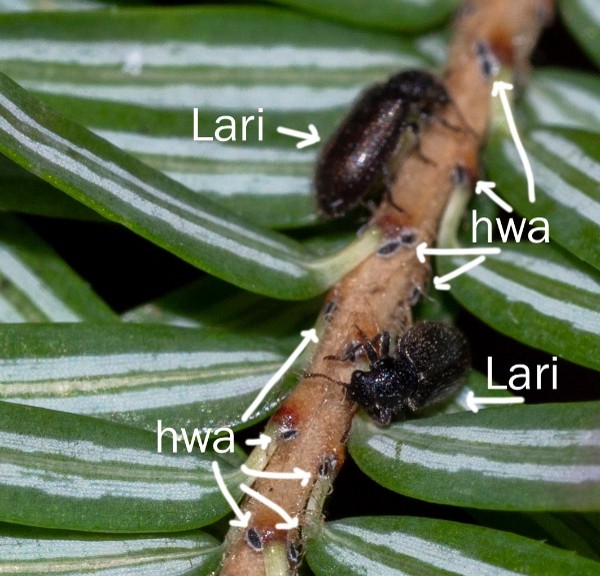
The goal of this effort is to identify hemlock trees and forest stands that are heavily infested with Hemlock Woolly Adelgid (HWA) and may serve as effective release sites for Laricobius nigrinus, a predatory beetle that feeds exclusively on HWA. Lari beetles help reduce adelgid populations to levels that allow hemlock trees to survive and remain healthy over time.
Laricobius nigrinus originated in the Pacific Northwest, where both the beetle and the adelgid coexist. In that region hemlock forests remain healthy in part because natural predators, including Laricobius beetles, help keep adelgid populations under control.
Understanding Hemlock Woolly Adelgid
As adelgid populations increase, they deprive trees of nutrients and water. Infested trees become weakened and may die within 2 to 12 years, especially if they are already under environmental stress. Infestation also leaves trees more vulnerable to secondary pests and diseases, including hemlock looper and elongate hemlock scale.
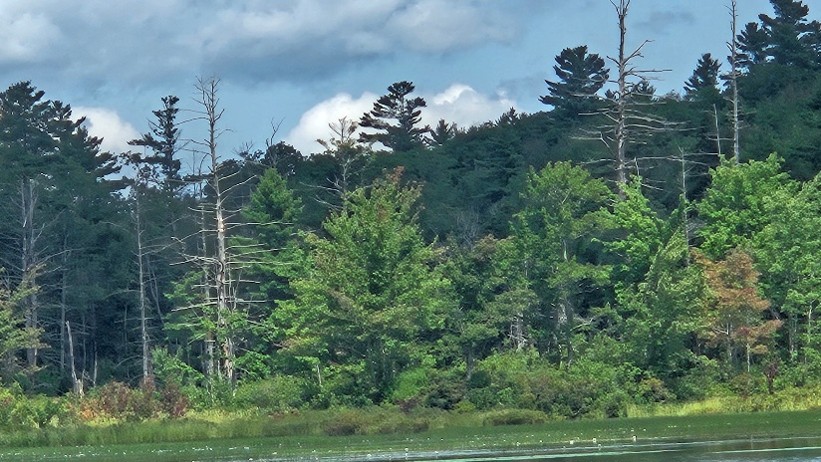
1 Newly Dead Hemlocks on Harrisville Pond (north shore)
What Makes a Good Release Site?
The best release sites have:
- Significant populations of Hemlock Woolly Adelgid.
- Multiple infested trees within a forest stand.
- Conditions that support beetle establishment and reproduction.
- Accessible branches that can be inspected and monitored.
Ideal locations may include:
- Forest openings or sunlit corridors.
- Pond edges.
- Roadsides and forest roads.
- Areas with younger hemlocks growing beneath larger trees.
While these characteristics are helpful, a site does not need to be perfect to be suitable for beetle release.
How to Assess an Infestation
1. Evaluate Adelgid Density on Branches
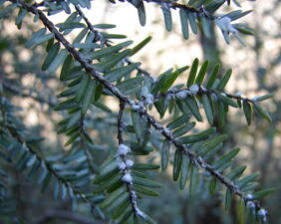
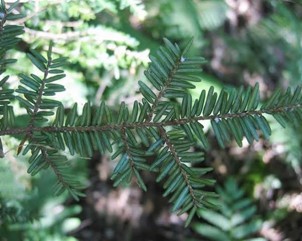
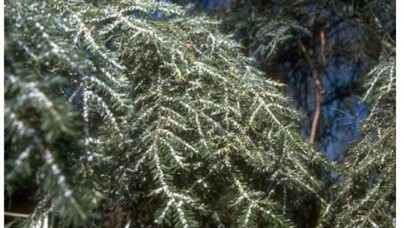
Light Infestation
Look for just one or two isolated white dots at the very base of the needles. The tree crown and branches will still look perfectly healthy, vibrant green, and full. They must flip individual twigs over and look closely near the outer tips of the branches.
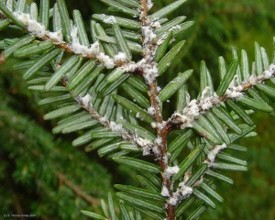
Medium Infestation
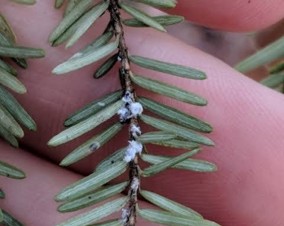
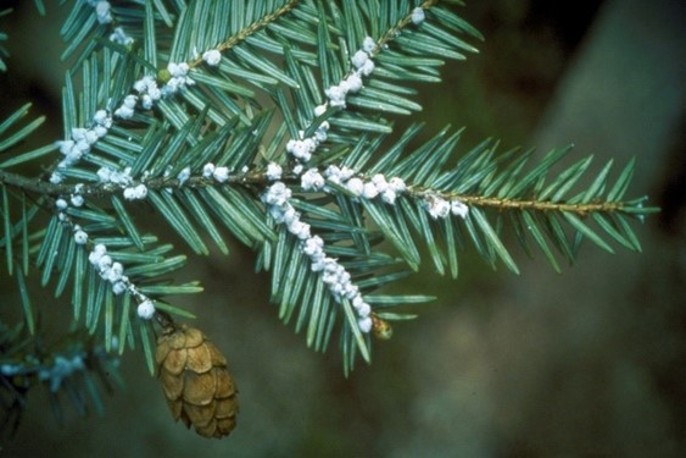
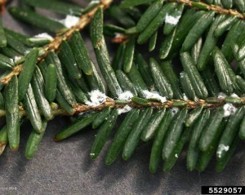
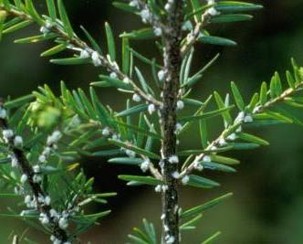
In a medium infestation, the insect population has begun to establish and multiply along the twig.
- white ovisacs are now forming a distinct, continuous line of cotton-like balls trailing down the twig. While the branch may still have plenty of green needles, you might begin to notice slight yellowing (chlorosis) or a subtle thinning of the foliage on that specific branch.
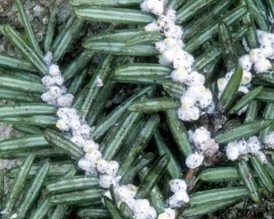
Heavy Infestation
A heavy infestation means the tree is under severe stress and requires rapid intervention to prevent mortality.
- The undersides of the twigs will be completely blanketed in thick, overlapping white wool. At this stage, macro-symptoms become highly visible: the tree’s needles will turn grayish-green or yellow, drop off entirely, and the crown will look sparse and thin against the sky.
2. Evaluate Tree-Wide Infestation
Estimate what percentage of the tree is affected:
- Less than 10%
- Between 10% and 50%
- More than 50%
3. Evaluate Surrounding Trees
Determine whether:
- Only one tree is infested.
- A small cluster of trees is infested.
- The infestation extends throughout the surrounding forest stand.
Areas with multiple infested trees are especially valuable because they provide enough food to support expanding beetle populations and bridges for beetles to travel to neighboring areas.
Where to Look on a Tree
Focus on hemlock branches that hang close to the ground, making them easy to inspect.
Look on the underside of the newest growth at the ends of branches, where adelgids are most commonly found. Trees with low branches are particularly attractive as release sites because beetles released there can move upward through the canopy and eventually spread into surrounding trees.
How Laricobius Beetles Help
Laricobius nigrinus beetles feed on both adelgids and the eggs in their egg sacs. Once established, they reproduce and form self-sustaining populations that gradually expand through the forest. As local food supplies decline, the beetles naturally disperse in search of additional adelgid-infested trees.
Some release sites may eventually become insectaries: locations where beetle populations become large enough that some beetles can be collected and transferred to new sites.
Documenting a Potential Release Site
When you find a potentially suitable location:
- Take close-up photographs of adelgid-infested branches.
- Photograph the entire tree.
- Photograph the surrounding stand or affected area.
- Record your observations about infestation severity and extent.
- Submit the information through the project’s QR code link or reporting system for evaluation.
Why Hemlocks Matter

Benefits of hemlock forests include:
- Winter shelter for deer, which often gather beneath hemlocks in large groups.
- Browse for porcupines and deer.
- Habitat for more than 150 species of birds and animals.
- Stabilization of forest and stream ecosystems.
When deciduous trees lose their leaves in winter, hemlocks continue to provide cover, food, and protection. Hemlocks shade and cool streams and ponds allowing native fish to thrive. The loss of hemlocks would fundamentally change the character and ecology of local forests.